


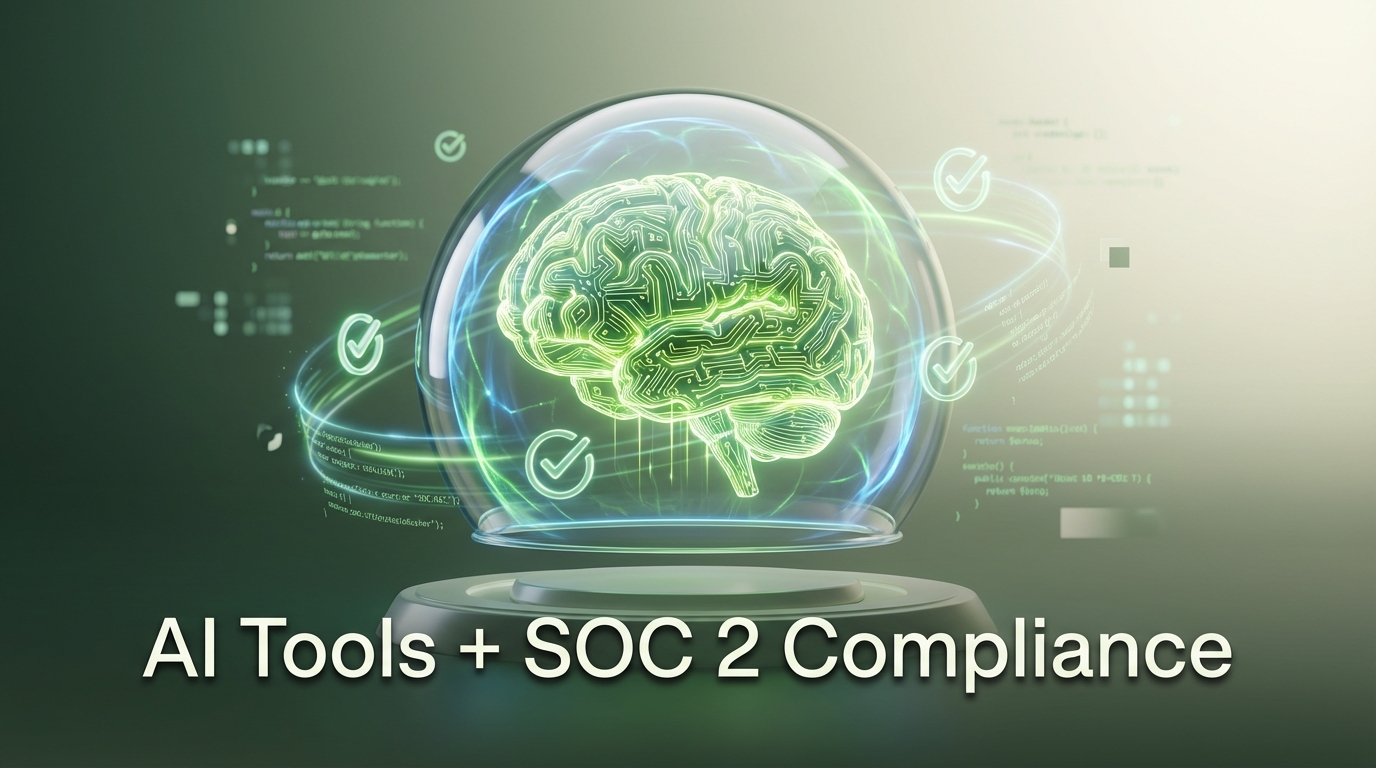
The AI Dilemma Tool Every Startup Compliant Faces
So here’s the question of keeping CTOs up at night: Can you actually use these AI coding assistants without blowing up your compliance posture?
But the practical answer requires an accurate understanding of what compliance requirements require, how different AI tools deal with your code, and what controls you need to implement.
With the compliance automation industry exploding in 2026, the intersection between AI tools and compliance frameworks is where real work happens.
What does SOC2 say about third-party tools
Before you dive into AI-specific tools, let’s clarify what requirements SOC2 actually requires when it comes to third-party software.
The Vendor Management Requirement
The Trusted Services Criteria of SOC2 include specific requirements with regard to provider and third-party risk management.According to the Common Criteria (CC9.2), organizations must assess and manage the risks associated with suppliers and business partners.
Here’s what it means in practice for the checklistSOC2:
- • Due diligence documentation: You need proof that you evaluated the AI tool’s security position before adoption
- • Contractual protections: Your agreements should address data management, security commitments and breach notification
- • Ongoing monitoring: Annual (at least) review of the compliance status of the supplier
- • Risk assessment: Documented analysis of the data accessed by the instrument and the associated risks
Major AI coding assistants, such as Claude, Copilot and Cursor, are built by companies that understand enterprise requirements. They have invested a lot in enterprise-level security certifications and controls.
For a deeper immersion in managing supplier relationships during your compliance journey, see vendor management resources.
Data processing and confidentiality control
The principle of confidentiality in the requirementsSOC2 becomes specific in terms of protecting sensitive information.When your developers use AI encryption assistants, fragments of code - potentially containing proprietary logic, keysAPIor customer data models - flow to external systems.
Your control should address:
- What data leaves the environment: What repositories, files, or sections of code can developers use with AI tools?
- How these data are processed: Does your AI service provider keep your code? how long? for what purposes?
- Who can access this data: What are the provider’s internal access controls?
- Where are these data: Does the data provider’s residence align with your commitments to customers?
This is where the distinction between and consumers becomes critical – and where many start-ups make mistakes that threaten compliance.
AI Coding Assistant Compliance Checklist
Here is the SOC2 specific checklist for the adoption of the AI coding tool.Document each item and you will have ready-to-audit evidence of appropriate supplier management.
1. Data Residency and Storage Policies
Before approving any AI coding assistant, answer these questions in writing:
Where is your code going?
- • Identify the provider's data center locations
- • Confirming compliance with any customer contractual requirements (especially for EU customers under GDPR)
- • Document if you can select specific regions for data processing
How long is it stored?
- • Distinction between transitory processing (the analyzed code then discarded) and persistent storage
- • Identify any caching mechanisms and their duration
- • Understand backup and disaster recovery implications
What's the legal jurisdiction?
- • Confirm which country's laws govern data handling
- • Assess implications for government access requests
- • Documentation of any relevant data protection certifications (SOC2, ISO27001, etc.)
For most enterprise-level artificial intelligence tools, you’ll find this information in their trusted centres or security documentation.
2. Code Snippet Retention Settings
This is where the compliance requirements of SOC2 become granular. Different AI tools have dramatically different approaches to keeping code:
- • Zero-retention options: Some enterprise plans offer settings in which your code is processed, but it is never stored for training or pattern improvement.
- • Training data policies: Most enterprise levels explicitly exclude the customer code from the training data – but you need to verify this in writing.
- • Conversation history: Even if the code is not kept for instruction, your chat history or session logs may persist.
💡 Action item: Create a configuration checklist for each approved AI tool.When developers are on board, they should configure retention settings before writing their first invitation.
3. Enterprise vs. Consumer Tier Differences
Here’s where startups often collide: the free or consumer level of an AI encryption assistant usually has very different data processing practices than the enterprise version.
Consumer/Free tiers commonly:
- • Retain code snippets for model training
- • Offer limited or no audit logging
- • Lack single sign-on (SSO) integration
- • Provide no data processing agreements (DPAs)
- • Have minimal access controls
Enterprise tiers typically include:
- • Explicit data retention controls
- • Comprehensive audit logs
- • SSO and SCIM provisioning
- • Associated Business Agreements or DPAs
- • Role-based access controls
- • Dedicated security reviews
The cost difference between levels often seems steep – until you compare it to the cost of failing an audit or losing a corporate business. The actual cost of compliance helps put these tool investments in perspective.
💡 Pro tip: If budget constraints force you to move towards consumption levels, implement compensatory controls.Restrict which deposits can be used with AI tools, request a code review before any AI-assisted commitments, and document these limitations in your policies.
4. Audit Log and Access Control Requirements
Your auditor will ask, “How do you know who used the AI tools, when and with what code?”
Strong audit log capabilities should include:
- • User identification: Which team member initiated each session
- • Timestamp records: When AI tools were accessed
- • Query logging: What prompts or fragments of code have been sent (or at least that queries have taken place)
- • Response tracking: What returned AI (for sensitive use cases)
Pentru controlul accesului, documentul:
- • Approval workflows: Who authorizes access to AI tools for new team members
- • Role-based permissions: Which team or people can use which tools
- • Offboarding procedures: How to revoke access when employees leave
- • Regular access reviews: Quarterly verification that only appropriate personnel have access
If your chosen AI tool does not have native audit logging, implement wrapping solutions or ask developers to manually record use.
Breakdown from one instrument to another: Claude, Copilot, Cursor and many more
Let’s examine the main AI coding assistants through a compliance lensSOC2. note that capabilities are evolving rapidly – check current offers before making decisions.
Claude (Anthropic)
- • Anthropic obtained the SOC2 Type II certification for its entrepreneurial offers
- • Claude for Enterprise includes zero retention options for prompts and outputs
- • Use API can be configured with specific data processing requirements
- • Enterprise plans include SSO, audit logs and dedicated security reviews
For compliance with SOC2, the key is to make sure you are at the right level with the right configurations enabled. Claude consumer use should be explicitly prohibited in your policy of acceptable use unless there are compensatory controls.
GitHub Copilot
As the most widely adopted AI coding assistant, Copilot has mature enterprise features:
- • Copilot Enterprise and Copilot Business offer code retention controls
- • Organizations can disable collection of code fragments for model training
- • Integration with GitHub's existing audit log infrastructure
- • SOC2 Type II certified as part of the wider alGitHub compliance program
Critical setting: Make sure that the “Public Code Matching Suggestions” lock is enabled if you are concerned about license compliance alongside security.
Cursor
The new participant quickly added enterprise capabilities:
- • Confidentiality mode options that prevent the storage of the code
- • Team plans with centralized administration
- • Growing security certification portfolio
Check current certifications directly with Cursor as their compliance documentation evolves with rapid growth.
Other Tools (Codeium, Amazon CodeWhisperer, Tabnine)
Each has different compliance postures:
- • Amazon CodeWhisperer: Advantages of AWS Extended Compliance Certification; Professional Level Includes Security Scanning
- • Tabnine: Offers on-premises deployment options for maximum control
- • Codeium: Enterprise tier includes SOC 2 compliance features
The common line: enterprise levels exist specifically because compliance-conscious organizations have requested them.
The issue of open source security
This is important for AI coding tools because many developers use AI assistants to work with open-source dependencies – and because some compliance tools themselves are open-source.
Here's the nuanced reality:
Open source is not inherently less secure. In fact, open-source transparency often allows for faster detection and correction of vulnerabilities. The Log4j incident, often cited as an open-source failure, was actually an open-source success story – the vulnerability was identified, revealed and corrected faster than most proprietary software incidents.
The real risk is uncontrolled dependence. Whether you use AI to generate code or write it manually, the security question is: Do you know what’s in your software supply chain?
For conformitySOC2, this means:
- • Software composition analysis: Implementation of tools that inventory open-source dependencies
- • Vulnerability monitoring: Subscribe to security tips for your addictions
- • AI-generated code review: Treat AI suggestions like any other code—review before committing
Suppliers who publish detailed security documentation, undergo regular third-party audits and openly engage with security researchers deserve more trust than those who operate as black boxes.
Create an acceptable AI usage policy for your team.
Documentation is the backbone of complianceSOC2.You need an official policy of acceptable use of AI that developers can recognize and follow.
Section 1: Approved Tools
List specifically which AI coding assistants are permitted:
- • Name of the tool and approved level (for example, "GitHubCopilot Business only")
- • Required configuration settings
- • Any repository or project restrictions
Section 2: Prohibited Uses
Be explicit about what's not allowed:
- • Consumption/free levels of approved instruments
- • Unapproved AI tools entirely
- • Sending a code containing customer data, credentials or secrets
- • Use of AI tools with repositories containing sensitive categories
Section 3: Required Practices
Mandate specific behaviors:
- • Code review requirements for AI-assisted commits
- • Secret scanning before any AI tool interaction
- • Reporting procedures for accidental sensitive data exposure
- • Regular training completion requirements
Section 4: Monitoring and Enforcement
Explain how compliance is checked:
- • Audit log review frequency
- • Consequences for policy violations
- • Exception request procedures
Section 5: Incident Response
Define what happens when things go wrong:
- • Who to contact if sensitive data is accidentally transmitted
- • Documentation requirements for incidents
- • Integration with broader incident response procedures
Make this policy part of employee hiring and request annual recognition. your auditor will want to see both the policy and the evidence that employees have agreed to it.
To guide the construction of comprehensive compliance documentation, SOC 2 guide Explain what auditors expect at each stage.
Conclusion: Embrace AI Without Compliance Anxiety
The question is not whether your team should use AI coding assistants - the ship has navigated. The question is whether you will proactively manage this use or discover compliance gaps during the next audit.
Here's your action summary:
- Audit current usage: Find out what AI tools your team already uses (probably, even if unofficial)
- Standardize on enterprise tiers: Budget for compatible versions of approved instruments
- Configure retention settings: Enable zero-retention or minimal-retention options
- Document everything: Create your acceptable AI usage policy and supplier risk assessments
- Teach your team: Make sure developers understand both capabilities and limits
- Monitor and review: Implementation of periodic access reviews and audit log analysis
The compliance automation industry exists because this work is truly complex – but it’s not impossible.
Your corporate clients ask about using AI tools in security questionnaires. Your auditors add AI-specific questions to their procedures. Overcoming this curve is not just about avoiding problems – it’s about confidently saying “yes, we use AI tools and here’s exactly how we manage them.”
The platform makes compliance for you
With the platform’s compliance service, we manage every step towards certification and keep you consistently in compliance afterwards. our automated platform tracks changes in all your tools and stacks, while your dedicated compliance officer meets with you at least once a quarter to review what’s new and make sure you keep everything up to date.
Start with the platform