



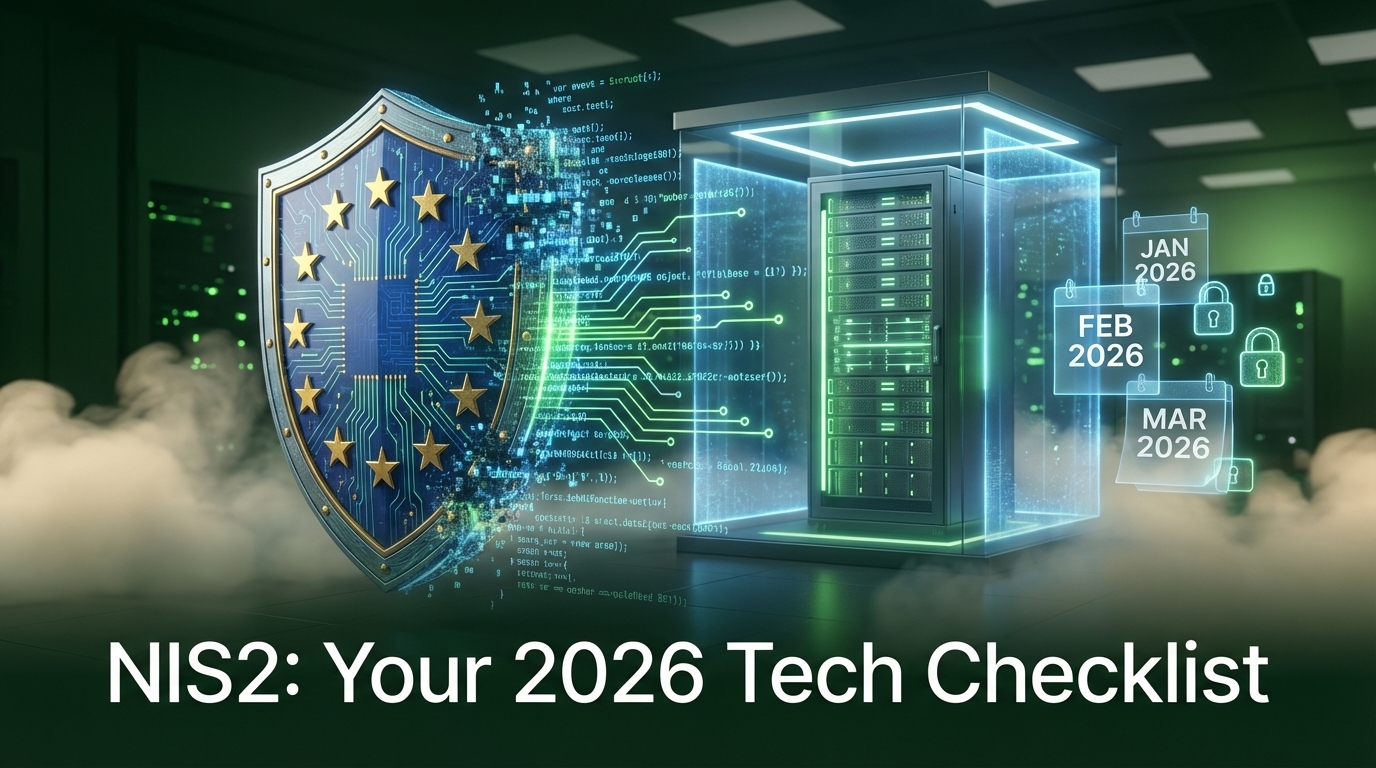
If you are a CTO, DevOps engineer or technical founder at a European start-up or scale-up, this regulation will fundamentally redesign how you architect your systems, manage incidents, and manage the entire supply chain.
Here is the unpleasant truth: According to a recent industry analysis, many companies struggle to comply with the requirements of NIS2, not because the rules are unjustified, but because the technical implications were not clear until implementation began.
This guide goes through the regulatory jargon and translates NIS2 into what you need to build, configure and document. Whether you are running infrastructure on AWS, managing a Kubernetes cluster, or shipping SaaS products to European customers, here is the roadmap for technical deployment.
NIS2 is not just a conformity checkbox (it is a technical review)
The original 2016 NIS Directive was a starting point.NIS2is a complete rewrite designed for modern threat landscapes.According to the European Commission’s digital strategy documentation, the directive responds to “increasing digitalization of the internal market” and to “an ever-evolving landscape of cybersecurity threats” – diplomatic language for “ransomware attacks undermine critical infrastructure and we need to do something about it”.
What makes caNIS2 different for technical teams?
Expanded scope
NIS2 covers significantly more sectors and entities. If you are building software for health care, energy, transportation, banking, digital infrastructure or even food supply chains, you are likely to be in the scope.
Personal accountability
Leading bodies can now be held personally responsible for failures in compliance. This means that your CTO or CISO is not only responsible for implementation – they are on the hook if things go wrong.
Harmonized enforcement
The European Union Agency for Cybersecurity (ENISA) plays a central coordinating role, and sanctions can reach EUR 10 million or 2% of the global annual turnover, whichever is greater.
Minimum security measures provided for in Article 21
Article 21 of NIS2 specifies ten minimum security measures that entities within the scope must implement.
Risk analysis and information system security policies
You need documented, regularly updated evaluations that cover the entire architecture of your information system.
Technical implementation:
- • Implementing automated asset discovery tools to maintain accurate inventory
- • Implementation of risk assessment methodologies (FAIR, NIST RMF or similar)
- • Create security policies that can be read by the machine and controlled by the version
- • Establishment of quarterly review cycles with documented change logs
2. Incident Handling Procedures
NIS2requires formalized incident management that goes beyond "we will figure out when it happens." You need documented and tested detection, analysis, content and recovery procedures.
Technical implementation:
- • Implementation of SIEM aggregation or log aggregation equivalent to defined detection rules
- • Creating runbooks for common types of incidents (ransomware, data breach,DDoS)
- • Implement automated alerting with clear escalation paths
- • Maintain incident response tooling (forensic images, network isolation capabilities)
Business Continuity and Crisis Management
This measure requires reserve management, disaster recovery and crisis management capabilities. For technical teams, this means that your infrastructure needs to be resilient by design.
Technical implementation:
- • Implement automated backups with tested restoration procedures
- • Deploy infrastructure-as-code for rapid environment recreation
- • RPO (Objective of Recovery Point) and RTO (Objective of Recovery Time)
- • Regular disaster recovery exercises with documented results
4. Supply Chain Security
This is where NIS2 becomes uncomfortable for start-ups. you are responsible for the security of the entire supply chain, including suppliers, contractors and third-party services. Why Code Review Matters to Compliance.
Technical implementation:
- • Maintain a comprehensive inventory of suppliers with security assessments
- • Implementation of access control for suppliers with minimum preference principles
- • Ask for security questionnaires and evidence from critical suppliers
- • Monitor third-party integrations for anomalous behavior
Every npm package, every Docker core image, every API integration represents a potential risk in the supply chain.
Procurement of networks and systems
Security must be considered throughout the entire life cycle of the system development – from procurement to deployment and maintenance.
Technical implementation:
- • Implement security requirements in procurement specifications
- • Implementation of secure CI/CD pipes with automatic security scanning
- • Requirements for safety testing before production
- • Maintaining secure configuration baseline for all systems
6. Vulnerability Handling and Disclosure
NIS2 requires systematic vulnerability management, including coordinated disclosure processes.
Technical implementation:
- • Implement vulnerability scanning on all assets (infrastructure, applications, containers)
- • Implement SLA-based patching timelines based on severity
- • Establish a vulnerability disclosure policy and process
- • Track Vulnerability metrics (average time to fix, patch coverage)
7. Cybersecurity Effectiveness Assessment
You should regularly evaluate whether the security measures really work.
Technical implementation:
- • Performing regular penetration tests (at least annually, quarterly for critical systems)
- • Implementation of security metrics and KPIs with dashboards
- • Perform tablet exercises and red team reviews
- • Commission independent security audits
The keyword here is "efficiency". Having controls is not enough - you need evidence that they work. if you need a pencil test forISO27001.
8. Cryptography and Encryption Requirements
NIS2 requires the proper use of encryption to protect data privacy and integrity. “Appropriate” means current standards, not old algorithms.
Technical implementation:
- • Implementing TLS1.3 for all external communications
- • Implementing resting encryption for sensitive data warehouses
- • Deploy certificate management with automated rotation
- • Document cryptographic standards and key management procedures
If you still support TLS1.1 or use SHA-1 anywhere in your infrastructure, compliance with NIS2 requires immediate remedy.
Security of human resources and access control
Security awareness and access control are interconnected. You need both trained people and technical controls that limit what they can access.
Technical implementation:
- • Implement role-based access control (RBAC) in all systems
- • Deploy identity management with regular access reviews
- • Automate onboarding/offboarding access provisioning
- • Maintain training completion records with assessment scores
Autentificare multi-factor si comunicatii sigure
MFA is explicitly required under NIS2, along with secure voice, video and text communications where applicable.
Technical implementation:
- • Implementation of MFA for all user accounts (preferred hardware keys, minimum TOTP)
- • Implementation of MFA for all administrative and privileged access
- • Deploy encrypted communication channels for sensitive discussions
- • Disable legacy authentication protocols that bypass MFA
The language “where appropriate” in the directive should not be interpreted freely.If an account can access sensitive data or systems, MFA is appropriate. Why the default settings of Google Workspace are unsafe.
NIS2 Incident Reporting: The Technical Requirements
The NIS2 requirements for incident reporting are among the most technically demanding aspects of the Directive.
24-Hour Early Warning Protocol
When you detect a significant incident, you have 24 hours to send an early warning to the competent national authority.
What you need to report:
- • if the incident is suspected to be caused by illegal or malicious acts;
- • Whether the incident could have cross-border impact
- • Initial assessment of incident severity
Technical requirements:
- • Automatic incident detection capable of identifying "significant" incidents
- • Alerting systems that notify appropriate personnel immediately
- • Early Warning Templates Ready for Rapid Submission
- • Clear criteria for what constitutes “significant” in your context
72-Hour Incident Notification Details
Within 72 hours, you must provide a more detailed notification, including the initial assessment, severity, impact and compromise indicators, where available.
What you need to report:
- • Updated severity and impact assessment
- • Indicators of compromise (IOCs)
- • Initial remediation actions taken
- • Estimated scope of affected systems and data
Technical requirements:
- • Forensic capabilities to gather IOCs quickly
- • Asset inventory sufficiently accurate to assess the scope of impact
- • Logging sufficient to reconstruct incident timeline
- • Documentation systems for tracking remediation actions
Building Automated Incident Detection
Manual execution of these timelines is almost impossible for most organizations.
Implementation approach:
- • Implementing SIEM with correlation rules aligned with your threat model
- • Implementation of automatic severity classification based on affected assets
- • Create automated notification workflows triggered by incident reporting
- • Build dashboards showing incident status against reporting deadlines
Using AI Tools While Staying NIS2 Compliant
The intersection between AI tools and compliance generates meaningful discussions. Technical teams wonder: can we use AI coding assistants whileining compliance?
AI Coding Assistants and Data Residency Concerns
AI encryption assistants process your code – and potentially your data – through external systems. subNIS2, this creates supply chain and data protection considerations.
Key questions to address:
- • Where does your AI provider process and store your code?
- • What data retention policies apply?
- • Does the provider itself comply with the relevant security standards?
- • How can you prevent the inclusion of sensitive data in AI calls?
Practical mitigations:
- • Implement code scanning to detect secrets before sending AI
- • Use AI tools with EU data residence options where available
- • Using AI Documentation Tools in Supply Chain Risk Assessment
- • Train developers on appropriate AI tool usage
Automated Security Monitoring Within NIS2 Bounds
Artificial intelligence-based security monitoring can strengthen your compliance position NIS2– when implemented correctly.
Compliant AI security use cases:
- • Detection of abnormalities in network traffic and user behavior
- • Automated log analysis and correlation
- • Threat intelligence enrichment and prioritization
- • Vulnerability prioritization based on exploitability
Implementation considerations:
- • Make sure AI security tools don’t create new data residence problems
- • Validate AI-generated alerts to avoid automation bias
- • Maintaining human supervision of AI-based security decisions
- • Documenting the capabilities and limitations of the AI tool in security policies
NIS2Compliance verification list for technical teams
Let’s consolidate everything in the runable checklists that your team can run.
Infrastructure Requirements
- ☐ Asset inventory covering all systems, applications and data warehouses
- ☐ Network segmentation with documented architecture
- ☐ Standby and transit encryption (TLS1.3, AES-256 minimum)
- ☐ MFA applied to all accounts with system access
- ☐ Automated backup with tested restoration procedures
- ☐ SIEM or equivalent log aggregation with retention that meets legal requirements
- ☐ Vulnerability scanning across all asset types
- ☐ Patch management with SLA-based timelines
Documentation Requirements
- ☐ Information Security Policy Approved by Management
- ☐ Risk assessment methodology and current assessment
- ☐ Incident response plan with defined roles and procedures
- ☐ Business Continuity and Disaster Recovery Plans
- ☐ Supply Chain Security Policy with Supplier Assessment Criteria
- ☐ Access control policy with RBAC documentation
- ☐ Cryptographic standards and key management procedures
- ☐ Training program with completion records
Testing and Audit Preparation
- ☐ Penetration testing completed within past 12 months
- ☐ Disaster recovery drill completed with documented results
- ☐ Incident response tabletop exercise completed
- ☐ Completed access review for all systems
- ☐ Vulnerability remediation metrics documented
- ☐ Security awareness training completion verified
- ☐ Third-party vendor assessments current
- ☐ Automatic collection of evidence where possible
Start the implementation today
NIS2 represents a fundamental change in the way European regulators approach cybersecurity. For technical teams, it’s not about adding compliance to existing processes, but about building security in your architecture, operations and culture.
The ten minimum security measures set out in Article 21 do not represent arbitrary bureaucratic requirements; they represent lessons hard gained from real incidents: ransomware attacks that shook hospitals, supply chain compromises that affected thousands of organizations, data breaches that exposed millions of records.
Key takeaways for technical teams:
- 1. Start with an assessment of the gap to the ten minimum measures
- 2. Prioritize incident detection and reporting capabilities – timelines are forgiving
- 3. Addressing supply chain security, including software dependencies
- 4. Automatic sampling from day one
- 5. Document everything in auditable, version-controlled formats
The deadline for enforcement of the law has passed, and regulators are actively monitoring organisations that do not comply.The question is not whether to implement the controlsNIS2– it is how quickly you can close your compliance gaps.
IfNIS2 overlaps with your ISO27001 orSOC2 efforts, learn about Choosing between SOC2 and ISO27001 and Talk to the platform To see how managed compliance can help.
